Research
Project 1: Perceptual Constancy
I currently work mainly on the philosophy of perception, and the problem of perceptual constancy in particular. I have been developing a theory of constancy that, I think, is explanatorily powerful in being a general theory, and seems to solve many historical puzzles to do with perceptual experiences involving constancy. One consequence of the approach I am developing is a Gestalt-shift approach to an aspect of the traditional appearance/reality distinction often associated with perceptual constancy.
Project 2: Normativity in Perception
Merleau-Ponty’s observation that objects have subjectively better perceiving conditions was recently defended and radicalised by Sean Kelly, who argues that perceptual experiences necessarily have a normative aspect – in seeing an object we are, necessarily, motivated to see it better. I became interested in this intriguing idea because it arises in connection with the experience of perceptual constancy. However, I now believe the connection is remote, and that the best interpretation of seeing “better” is “with higher confidence”, which is only indirectly related to constancy – or, for that matter, to motivation. Currently I am working on how confidence fits in to the phenomenology of perception.
Project 3: Other Minds and the Problem of Consciousness (on the back burner)
I have also been looking at the way in which our social nature impacts on our everyday understanding of consciousness. The traditional view is that the concept of consciousness arises from our reflections on our own experience; our understanding of the consciousness of other people is normally regarded as derived from this. But there is quite a lot of evidence that this is not the case. It is quite likely that our conceptions of ourselves as “seats of awareness” is jump-started by our realisation, as infants, that there are “others” around. I am interested in the effect of this, on what a general theory of consciousness should explain.
Research Grants
I am currently the recipient of a Japanese Government (JSPS) Grant-in-Aid for Young Scientists (若手研究), for a three-year project titled “Understanding Perceptual Representation”.
Selected Publications
“Art and Ambiguity: A Gestalt-Shift Approach to Elusive Appearances.” In Phenomenal Presence, edited by F. Macpherson, M. Nida-Rümelin & F. Dorsch, Oxford: Oxford University Press, forthcoming. Reveal abstract
I defend a solution to a long-standing problem with perceptual appearances, brought about by the phenomenon of perceptual constancy. The problem is that in conditions which are non-ideal, yet within the range that perceptual constancy works, we see things veridically despite an “appearance” which is traditionally taken to be non-veridical. For example, a tilted coin is often taken to have an “elliptical appearance”, shadowed surfaces a “darker appearance”. These appearances are puzzling for a number of reasons. I defend and elaborate on an approach taken by Sean Kelly, and earlier by the art historian E.H. Gombrich, according to which we can be tricked by our ability to bring about a kind of Gesltalt shift between different possible perceptual interpretations of a scene.
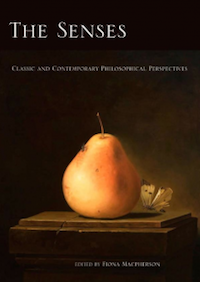
“A Proprioceptive Account of the Senses.” In Fiona Macpherson (ed.), The Senses: Classical and Contemporary Philosophical Perspectives. Oxford University Press. 2011. Reveal abstract
Representationalist theories of sensory experience are often thought to be vulnerable to the existence of apparently non-representational differences between experiences in different sensory modalities. Seeing and hearing seem to differ in their qualia, quite apart from what they represent. The origin of this idea is perhaps Grice’s argument, in “Some Remarks on the Senses,” that the senses are distinguished by “introspectible character.” In this chapter I take the Representationalist side by putting forward an account of sense modalities which is consistent with that view and yet pays due regard to the intuition behind Grice’s argument. Employing J.J. Gibson’s distinction between exploratory and performatory behaviour, I point to a proprioceptive element in perceptual experience, and identify this as crucial in any account of what makes a particular way of perceiving a sense modality.
“Transparency and the Unity of Experience.” In E. Wright (ed.), The Case for Qualia. MIT Press. 2008. Reveal abstract
If we assume that the operation of each sense modality constitutes a different experience – a visual experience, an auditory experience, etc – we are faced with the problem of how those distinct experiences come together to form a unified perceptual encounter with the world. Michael Tye has recently argued that the best way to get around this problem is to deny altogether that there are such things as purely visual (and so forth) experiences. Here I aim to show not simply that Tye’s proposed solution fails, but that its failure is highly instructive because it allows us to see that the transparency thesis, which lies at the heart of the case against qualia, and of most representationalist theories of experience, is more problematic than is often supposed.
“The Value in Equal Opportunity: Reply to Kershnar.” Journal of Applied Philosophy 24 (2):177–187. 2007. Reveal abstract
Stephen Kershnar (2004) recently argues that under its most plausible interpretation, equality of opportunity is simply not something worth pursuing; at least, not for itself. In this paper I try to show that even if we accept Kershnar’s characterisation of equality of opportunity in terms of weighted aggregate chances, none of his objections succeed. Opportunities, not outcomes, are the appropriate focus of EO advocates; hedonic treadmills are irrelevant to the issue; we do not need to assume general equality in some attribute to ground equality of opportunity; finally, it is possible to show that it is permissible to promote EO at some cost to other independent values.
“Representationalism, Supervenience, and the Cross-Modal Problem.” Philosophical Studies 130 (2):285-95. 2006. Reveal abstract
The representational theory of phenomenal experience is often stated in terms of a supervenience thesis: Byrne recently characterises it as the thesis that “there can be no difference in phenomenal character without a difference in content”, while according to Tye, “[a]t a minimum, the thesis is one of supervenience: necessarily, experiences that are alike in their representational contents are alike in their phenomenal character.” Consequently, much of the debate over whether representationalism is true centres on purported counter-examples – that is to say, purported failures of supervenience. The refutation of putative counter-examples has been, it seems to me, by and large successful. But there is a certain class of these for which the representationalist response has been something less than completely convincing. These are the cross-modality cases. I will explain what I mean, and then argue that the response in question is not only unconvincing but actually undermines the representationalist position.
“The Indexical Nature of Sensory Concepts.” Philosophical Papers 32 (2):169-181. 2002. Reveal abstract
This paper advances the thesis that sensory concepts have as a semantic component the first person indexical.
My poster on perceptual constancy for the 2011 Kyoto conference of the Association for the Scientific Study of Consciousness (ASSC) can be downloaded
here (PDF).